CULTURE · 2026-08-13
Dosirak and Party Science: Why Japchae Loves Room Temperature
By Japchae Curator
Japchae is Korea's ideal packed and party dish — it holds at room temp when rice won't, and the science explains why.
TL;DR
Japchae is Korea's ideal packed and party dish — it holds at room temp when rice won't, and the science explains why.
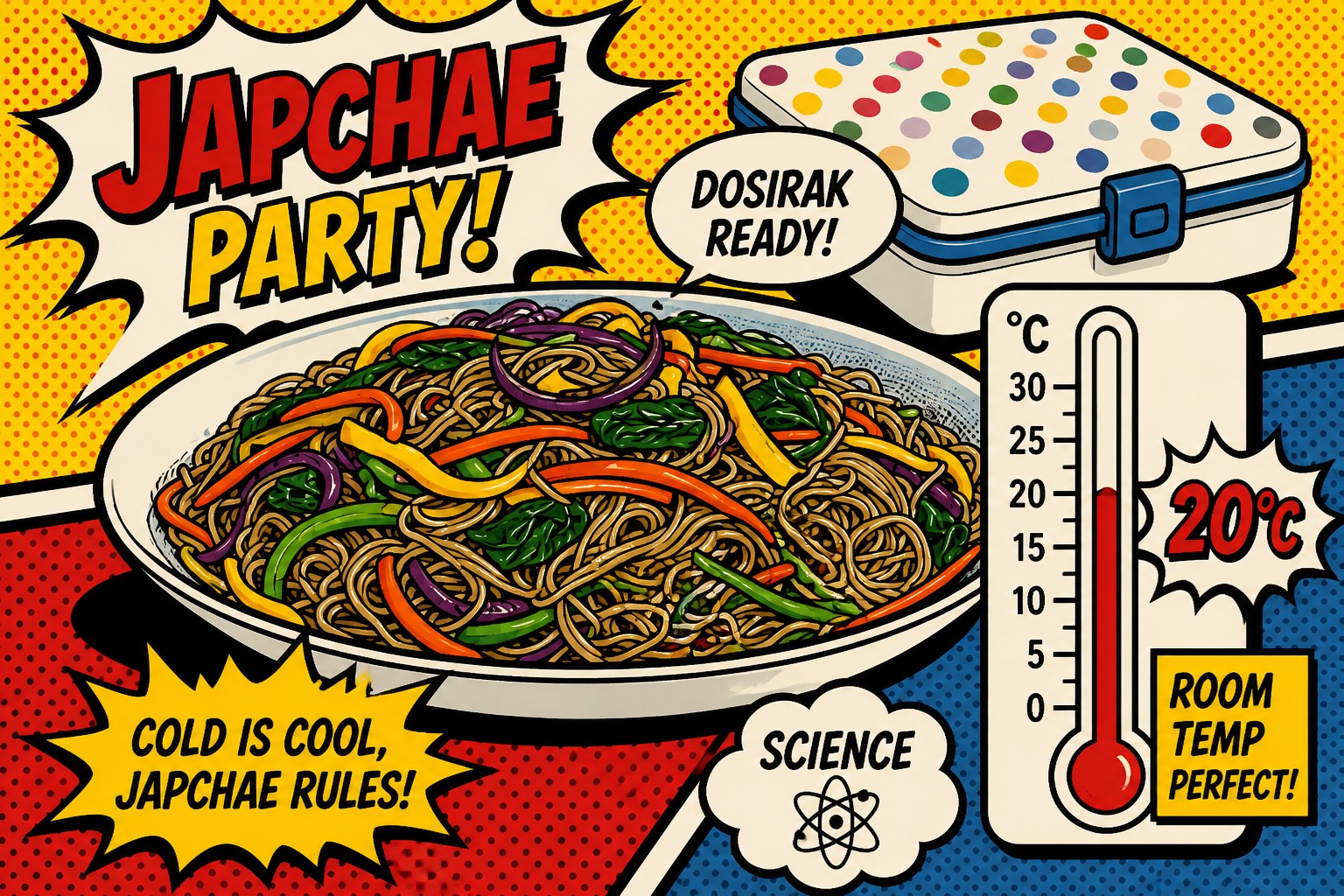
Japchae dominates Korean dosirak and holiday tables because sweet potato starch behaves differently from rice starch. Retrogradation firms rice into a hard pellet when cold, but dangmyeon stays pliable at room temperature and only needs a brief re-toss to re-gloss, making it commute and buffet friendly.
Food safety still applies. Japchae with beef or spinach should not sit above 70°F for more than 2 hours; the trick is that it is more forgiving than rice for a 60–90 minute service window and does not require constant heat. Keep it covered to prevent surface drying, not because it collapses when cool.
That holding power explains its role on Chuseok and Seollal tables alongside jeon, galbi-jjim, and namul — a room-temp anchor among dishes that wilt or congeal. Cooks make it first, pile it on a large platter, and let everyone self-serve without timing stress.
Pack smart for picnics. Toss noodles more generously with sesame oil (add 1 tsp extra) when serving cool, loosen with 1 Tbsp warm water per 400g just before packing, and tuck pickled radish on the side so its brine does not pool. The noodles will drink a little oil as they sit — that is expected.
Leftovers at room-temp events became nostalgia by accident. Many Koreans grew up eating leftover japchae from a shared plate with chopsticks between classes — not plated fine, just correct, glossy, and communal. That memory is the marketing you cannot manufacture for a party tray.
Across the Kimchee Network
More from the Kimchee Network